On August 18, 2026, Marco Island voters decided whether the city could borrow $23 million to replace two failing bridges and repave roughly 30 miles of road. When all three precincts reported that night, the count stood at 2,257 in favor and 2,256 against. One ballot. Out of 4,513 cast. The margin was so thin that Florida law required a recount, and after a machine pass and then a hand count, the Collier County Supervisor of Elections certified the final tally on August 26: 2,259 to 2,258. Still one vote.
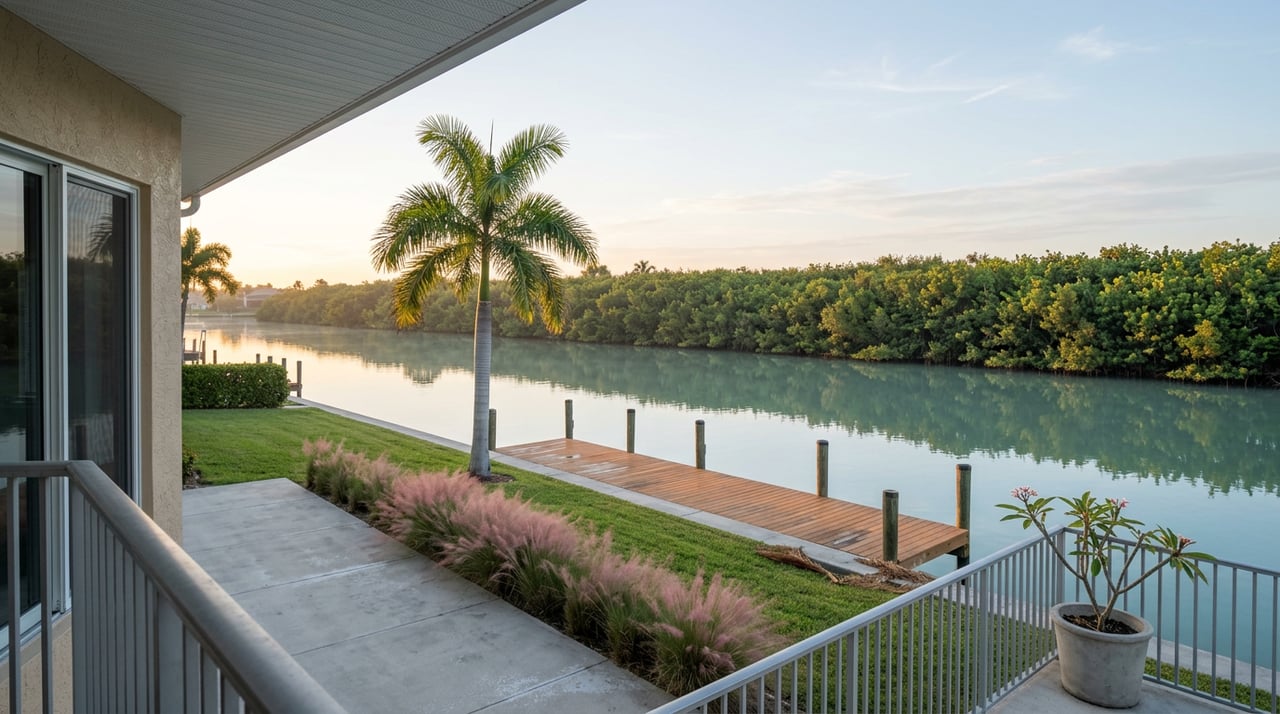
If you're comparing canal-front listings on Marco Island right now, that recount matters less for what it approved than for what it exposes. The bridges being replaced, the water treatment plant being upgraded, the canals that have gone undredged since the 1960s all sit downstream of decisions this close. A listing sheet will tell you dock length, seawall footage, and whether the access is direct or bridge-restricted. It will not tell you that the public infrastructure keeping that canal navigable and clean is being funded, argued over, and in one case decided by a single ballot, in real time.
The Number the Listing Sheet Won't Show You
Marco Island has roughly 100 miles of man-made canals, dug in the 1960s when the island was platted, and they have never been dredged. The city has been on Florida's impaired waterways list since 2019 because of elevated nitrogen levels, a designation the state assigns when a waterway can't reliably support its intended uses, including fishing and swimming. Excess nitrogen feeds algae growth, and algae blooms consume oxygen and cloud the water column, which is the visible "gunk" residents have been photographing and reporting to the city's Waterways Committee for years.
None of this shows up in an MLS listing because it's not a defect of any single property. It's a shared condition of the water itself, and it's the kind of variable that shapes long-term desirability the same way school zoning or road noise does, just slower and less visible at closing.
Two Timelines: The Fix That Got Rejected and the Ordinance That Passed
The city has looked at dredging before. A 2021 study put the cost of removing built-up sediment from the entire canal system at roughly $200 million, and the council shelved the idea as too expensive. In 2025, an Illinois firm called Earthwerks pitched a cheaper alternative: mechanical dredging paired with the construction of mangrove-covered islands from the dredged material, an approach it branded the Coastal Habitat and Water Quality Initiative, or C-HAWQ. The pitch came in at $60 million, with Earthwerks covering the cost of permitting and engineering studies up front.
The city hired Naples-based Humiston & Moore Engineers to review it. Their report, delivered in December 2025, found the proposal lacked answers on which agencies would have oversight, how erosion of the new islands would be controlled, and who would maintain them once built. The council voted it down on December 8 as too conceptual to move forward.
That left the comprehensive fix for the canals, the dredging that would remove decades of accumulated sediment, without a funded path. What the city did fund instead was narrower. On May 4, 2026, the council unanimously passed an ordinance to upgrade its wastewater treatment plant to Advanced Wastewater Treatment, or AWT, standards. A month earlier, engineering firm Black and Veatch had presented three cost alternatives, and the council settled on the most economical, estimated at $7 million to $8 million in capital costs with $500,000 to $800,000 a year to operate, roughly $19 million over 20 years. An independent evaluation presented the same day estimated the change would add less than $11 a month to the average household water bill.
Those numbers have moved before. A 2022 estimate from a different engineering firm put the AWT conversion at $4 million to $9 million. When Black and Veatch produced its own range earlier in 2026, before the council narrowed to Alternative One, the estimate spanned $5 million to $14 million. Infrastructure cost estimates on a project like this tend to tighten as engineers get more specific, and Marco's kept moving even in its final year of planning.
How Marco Island Is Actually Paying For This
| AWT Plant Upgrade | Transportation Bond | |
|---|---|---|
| What it funds | Wastewater plant nutrient reduction | Caxambas and Goldenrod bridge replacement, road repaving |
| Funding mechanism | Utility rate increase | Property tax (general obligation bond) |
| How it was approved | City Council ordinance, unanimous | Voter referendum, passed by 1 vote |
| Approved | May 4, 2026 | August 18, 2026, certified August 26, 2026 |
| Estimated cost to homeowners | Under $11 per month | About $60 per year on a $580,000 taxable home |
The distinction matters at closing. The AWT cost shows up as a rate increase on a water bill, not as a special assessment tied to the property, so it won't appear as a line item during a title search. The bond cost shows up in the millage rate on the annual tax bill, citywide, regardless of whether a given home sits on open water or three streets back. Neither is a per-property lien. Both are part of what it now costs to own on the island going forward.
What AWT Fixes, and What It Doesn't
Even the ordinance's supporters don't claim it solves the whole problem. Vice Chair Rene Champagne has described the city's water strategy as three pillars: AWT, muck removal, and improved circulation and oxygenation in the canals. AWT addresses one of those. The water and sewer utilities general manager, Jeff Poteet, has argued for years that the existing plant already uses advanced membrane technology and that converting the septic systems in neighboring Goodland and Isles of Capri, both of which Marco's utility also serves, would do more for water quality than upgrading a plant he considers already state of the art.
A resident-led group called Clean Marco Waters LLC has pushed back on that framing, pointing to its own 2025 testing that it says found caffeine and sucralose, both markers commonly associated with human wastewater, in canal samples. Whether that testing settles the debate or not, it illustrates the gap between the fix that's now funded and the fix that would actually remove what's already sitting on the canal bottoms. With the C-HAWQ dredging proposal dead and no new dredging plan on the table, muck removal, one of Champagne's three pillars, currently has no funding mechanism at all.
The Bond That Came Down to One Ballot
The transportation bond is a separate fight with its own math. City staff had identified roughly $57 million in transportation capital needs, not counting debt service, and some councilors argued the real 20-year need approached $100 million. The council narrowed its ask twice, first rejecting a $55 million proposal in an April 3-3 tie, then settling on $23 million for the August ballot rather than risk voters rejecting a larger number outright.
They were right to worry about the margin, just not about the size. The $23 million bond nearly failed anyway, passing by a single certified vote after a full recount. It authorizes the city to borrow against its property tax base to replace the Caxambas Bridge, currently rated as the lowest-scoring bridge among Collier County's 370 by sufficiency, along with the Goldenrod Bridge, plus repairs to three additional bridges and roughly 30 miles of repaving. The city council still has to formally authorize the borrowing, expected at a meeting in the second week of September 2026, and City Manager Casey Lucius has said it could be several months after that before the first funds arrive.
What This Means If You're Evaluating a Canal-Front Listing
A few questions are worth asking before you write an offer on Marco Island waterfront, regardless of price point.
- Ask whether the specific canal is a dead end or flows through to open water. Circulation affects how quickly nutrients disperse, and dead-end canals tend to show algae buildup faster than through-flow canals.
- Ask the seller or listing agent if they have any recent water testing for that stretch of canal, whether from the city, a homeowners group, or Clean Marco Waters LLC's published results.
- Confirm whether your dock sits near a reclaimed water outfall or heavy irrigation use nearby, since reclaimed water is one of the pathways advocates point to for nutrient loading.
None of this should scare a buyer off Marco Island waterfront. It should change what you're underwriting. You're not just buying a dock and a view. You're buying into a multi-decade public infrastructure plan that is currently one-third funded, still being debated by the people who live there, and subject to votes that, as this August proved, can come down to a single ballot.
A short FAQ
Will the AWT upgrade show up as a special assessment at closing? No. It's structured as a utility rate increase, phased in through monthly water bills, not a one-time assessment tied to the property.
Does the bridge replacement affect boat clearance under the Caxambas Bridge? The certified bond funds the Caxambas Bridge replacement, but the city has not published final clearance specifications as of this writing. If you're evaluating a lot where mast height or vertical clearance matters, confirm current plans with the city's public works department before you close.
Is Marco Island's canal water unsafe? The city remains on Florida's impaired waters list, and nitrogen levels have declined but haven't yet triggered removal from that list. The city operates under an FDEP-approved restoration plan. Reviewing that plan and any available recent testing is reasonable due diligence for any waterfront buyer here, the same way you'd review a seawall inspection or a flood elevation certificate.
Marco Island's waterfront market has always priced scarcity well. What it hasn't priced yet is which canals get cleaner over the next decade and which stay exactly as they are. That's not a question a comp sheet can answer, and it's exactly the kind of local, moving detail our team tracks so our buyers and sellers aren't finding out about it after closing. If you're weighing a canal-front purchase or sale on Marco Island, MJ Team can walk you through what's actually funded, what's still in play, and how to read a listing with both in mind.